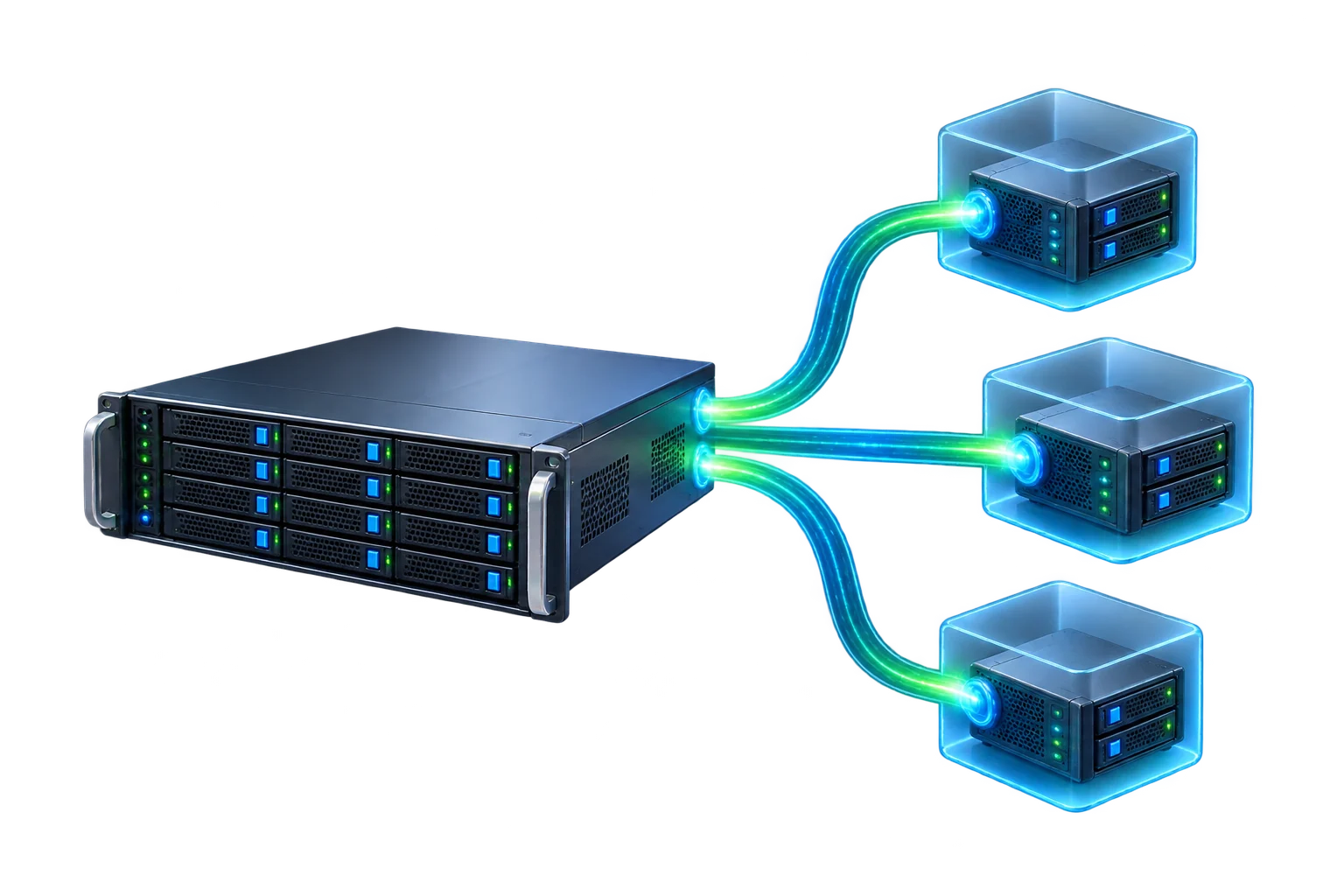

A VPS and a dedicated server both offer root access and predictable, reserved resources — which is exactly why the choice between them is less obvious than shared hosting vs. either one. For a primer on how both compare to shared hosting first, see Shared Hosting vs. VPS vs. Dedicated Servers; this piece assumes that groundwork and goes deeper into the VPS-vs-dedicated decision specifically, including what a VPS actually gives you day to day. The meaningful differences between the two show up under specific conditions: sustained high load, strict compliance requirements, or workloads sensitive to the small overhead virtualization introduces.
The real difference: virtualization overhead
A VPS runs on top of a hypervisor, which mediates access to the physical CPU, memory and storage beneath it. That mediation layer is highly optimized in modern virtualization platforms and typically costs only a few percent of raw performance — for the overwhelming majority of workloads, it's not noticeable. A dedicated server has no hypervisor at all: the operating system talks directly to the physical hardware, with no virtualization overhead and no resource contention from a "noisy neighbor" VM on the same host, because there is no other tenant on the host at all.
Performance: where dedicated pulls ahead
For typical web application workloads — a CMS, an API backend, a small-to-mid-size database — a correctly sized VPS performs indistinguishably from equivalent dedicated hardware in practice. The gap widens for specific patterns: workloads with sustained, near-100% CPU utilization across all cores; applications extremely sensitive to I/O latency jitter, where even the small variability a hypervisor can introduce matters; and large in-memory databases or caches where every byte of RAM needs to be either fully utilized or precisely accounted for, without a hypervisor's own memory management overhead in the picture.
Cost: per-unit capacity vs. total spend
Dedicated servers cost more in absolute terms than a VPS with comparable specifications, because the customer is paying for the entire physical machine rather than a share of one. But the comparison that actually matters is cost per unit of usable capacity at the workload's real scale: a small VPS is cheaper than a small dedicated server, but a workload that would otherwise require several large VPS instances — for redundancy or to work around per-instance resource ceilings — can sometimes be served more cost-effectively by one appropriately sized dedicated server, once VPS instance count and management overhead are factored in rather than list price alone.
Control, isolation and compliance
Both models provide root access, so day-to-day control over the software stack is similar. The difference is at the hardware layer: a dedicated server provides sole use of the physical machine, so no other customer's workload ever shares it — which matters directly for certain compliance frameworks and data-residency requirements that specify physical isolation, not just logical isolation enforced by a hypervisor. For workloads without that specific requirement, a VPS's hypervisor-enforced isolation is, in practice, extremely robust — but "robust in practice" and "contractually specified physical isolation" are different things, and some regulatory or enterprise-client requirements specifically ask for the latter.
Scalability: which one grows more easily
VPS instances are typically easier to resize upward on short notice — often within minutes, since it's a resource-allocation change on existing virtualized infrastructure rather than a hardware provisioning step. Scaling a dedicated server usually means provisioning new or upgraded physical hardware, which takes longer. This makes VPS the more flexible option for workloads with unpredictable or rapidly changing resource needs, and dedicated hardware the better fit once a workload's baseline resource requirement is large and stable enough that the provisioning lead time stops being a practical concern.
Management overhead: what each one actually asks of a team
On paper, both an unmanaged VPS and an unmanaged dedicated server ask the same thing of whoever administers them: patch the OS, harden SSH, configure a firewall, monitor for compromise, manage backups. In practice the day-to-day overhead is similar per server — but a dedicated server tends to add a second layer a VPS doesn't: hardware itself. RAID arrays, disk health, power supplies, and physical remote-access tooling (out-of-band management, for reinstalling an OS or recovering a server that won't boot) are all things a VPS customer never has to think about, because the hypervisor and the host provider absorb that layer entirely. This is one of the more underrated arguments for staying on VPS longer than the pure performance numbers might suggest: it's not just cheaper, it's operationally simpler, right up until a workload's scale genuinely requires the exclusivity dedicated hardware provides. Managed plans, where available for either tier, shift most of this overhead back to the provider regardless of which one is chosen.
Three realistic scenarios
A SaaS product with steady, moderate traffic. A B2B tool with a few hundred active daily users, predictable usage patterns tied to business hours, and a database that fits comfortably in memory on a mid-size instance. This is a strong VPS case: the workload isn't pushing any single resource to its limit, root access covers every customization the application needs, and the ability to resize on short notice matters more here than shaving a small hypervisor overhead that isn't the bottleneck anyway.
A fintech platform with a data-residency requirement. The application itself might be entirely ordinary from a resource standpoint — moderate traffic, a standard database — but a client contract or regulatory framework specifically requires that customer data never share physical hardware with any other tenant. Here the decision isn't about performance at all; it's the compliance requirement in "Control, isolation and compliance" above that settles it, and a dedicated server is the right call regardless of how modest the actual resource usage is.
A high-traffic media site with a large, hot database. Sustained high concurrent readers, a database working set too large to be forgiving of any I/O jitter, and CPU utilization that's consistently high rather than bursty. This is the profile in "Performance" and "Decision signals" below where the accumulated small costs of virtualization — the few percent of overhead, the shared I/O path, the memory-management layer — start to add up to a real, measurable difference, and where the largest VPS tier is already being fully used rather than held in reserve.
Migration considerations: VPS to dedicated
Moving from VPS to dedicated hardware is operationally similar to any other infrastructure migration, with a few dedicated-specific details worth planning for. Provisioning lead time is longer than a VPS resize — budget for it rather than starting the process once the current VPS is already struggling under load. RAID configuration is a decision that doesn't exist on a VPS (the host's storage redundancy is the provider's concern, invisible to the tenant) but does on a dedicated server, and it's worth setting up correctly at provisioning time rather than after data is already on the disk — see RAID Explained for Servers for what the common RAID levels actually trade off. As with any tier change, plan the DNS cutover in advance — see A Practical Guide to DNS for lowering TTLs ahead of a planned cutover — and keep the old VPS running in parallel until the new dedicated server has been under real production load for at least a few days, so there's a fast rollback path if something unexpected surfaces.
The signals that indicate you need bare metal
A workload is genuinely ready to move from VPS to dedicated hardware when several of these are true at once, not just one in isolation: CPU or memory utilization stays consistently high even on the largest available VPS tier; the application is highly sensitive to I/O or network latency variance, and monitoring shows that variance correlating with load from other tenants rather than the application's own behavior; a compliance requirement specifically mandates physical server isolation; or the total cost of the VPS instances required to handle current load, including redundancy, has converged with or exceeded the cost of equivalent dedicated hardware. Absent those specific signals, staying on a well-sized VPS — including ANYSRV's own VPS Hosting plans — usually remains the more practical and cost-efficient choice; when they are present, ANYSRV's Dedicated Servers are built for exactly that transition.