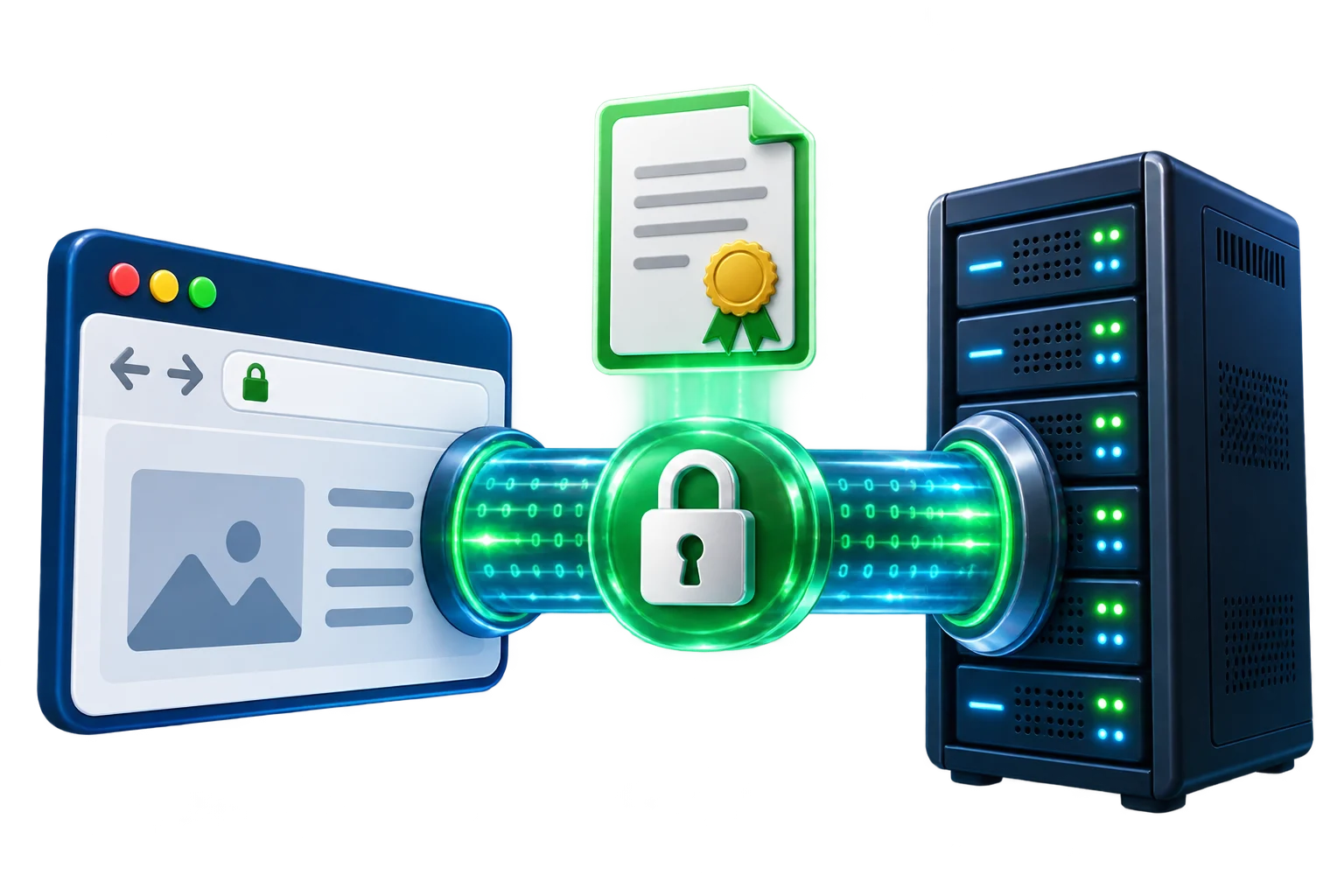
The three SSL certificate validation levels — Domain Validated, Organization Validated and Extended Validation — get compared as if they were tiers of security, but that framing is misleading. A more detailed look at what a certificate does in general is worth reading first if this is new territory — see SSL Certificates Explained. This piece focuses specifically on what separates the three validation levels and which businesses actually benefit from the higher ones.
The encryption is identical — the verification is not
A DV certificate and an EV certificate protect a connection with exactly the same cryptographic strength. Neither is more "secure" in the sense of being harder to break or providing stronger encryption — that part of a certificate's job is standardized and doesn't vary by validation level. What varies entirely is how much the certificate authority verified about the entity requesting the certificate before issuing it, which is a statement about identity assurance, not about connection security. Treating a higher validation level as "more secure" in the technical sense is the most common misunderstanding about the three tiers, and it leads some businesses to overspend on EV expecting a security benefit that the certificate itself doesn't actually provide beyond what DV already covers.
DV in detail: fast, automated, domain-only
Domain Validated certificates confirm exactly one thing: that whoever requested the certificate controls the domain it's for. Verification is typically automated — a DNS record, an email to an address at the domain, or a file placed on the web server — and issuance can complete in minutes without any human review. This is sufficient identity assurance for the overwhelming majority of websites, including most e-commerce, because the encryption strength is identical to OV or EV and domain control is, in practice, the property visitors actually rely on implicitly when they see the padlock.
OV in detail: verified organization identity
Organization Validated certificates add a manual verification step: the certificate authority confirms the requesting organization is a real, registered legal entity, typically cross-referenced against official business registries. This takes longer than DV — usually one to a few business days rather than minutes — and the verified organization name becomes part of the certificate's own details, visible to anyone who inspects it directly (though not surfaced prominently in the browser UI itself). OV is a reasonable middle ground for businesses that want that verified identity on record without the more extensive vetting EV requires.
EV in detail: the highest verification bar
Extended Validation certificates require the most thorough process: legal existence, physical address and operational status are confirmed through multiple independent sources, not just a single registry check. Browsers historically displayed EV certificates with a distinct green address-bar indicator showing the verified organization name directly; most current browsers no longer surface that visual distinction as prominently as they once did, which has reduced one of EV's more visible practical benefits over the past several years. The verified details remain embedded in the certificate itself regardless, available to anyone who checks — the change is in how much browsers surface that automatically to an average visitor.
Side-by-side comparison
| Factor | DV | OV | EV |
|---|---|---|---|
| What's verified | Domain control only | Domain + registered organization | Domain + organization + physical/legal existence |
| Issuance time | Minutes, automated | 1–few business days | Several business days to weeks |
| Encryption strength | Identical | Identical | Identical |
| Organization name in certificate | No | Yes | Yes, most thoroughly verified |
| Typical cost | $ | $$ | $$$ |
Checking which validation level a site is actually using
Verifying a certificate's validation level takes the same first steps as checking any certificate: click the padlock icon in the browser's address bar, open the certificate details, and view the certificate itself. For a DV certificate, the "Subject" field typically contains only the domain name, with no organization listed. For an OV or EV certificate, the Subject field additionally includes the verified organization name, its registered location, and related legal-entity details — that's the direct, visible difference between the levels once you know where to look, rather than relying on any indicator in the browser chrome itself, which — as noted above — no longer reliably surfaces this distinction the way it once did for EV specifically. This is worth checking directly on a site's own certificate periodically, particularly after a renewal, since it's possible to unintentionally renew into a different validation level than originally intended if the process isn't explicit about which one is being purchased.
A scenario: a growing B2B software company
A software company selling to mid-size and enterprise clients launches with a DV certificate — the standard, sensible default — and it serves the business well for the first couple of years. As the client base grows to include larger organizations with their own procurement and security-review processes, the company starts fielding a recurring question during sales cycles: prospective clients' security teams ask for confirmation of the vendor's verified legal identity as part of a vendor-assessment checklist, something a DV certificate's Subject field doesn't provide directly. At that point, moving to an OV certificate is a proportionate response — it directly answers a question that's now coming up repeatedly in a specific, business-relevant context, rather than being a hypothetical improvement. The company doesn't need EV: the specific gap being closed is "a verified legal entity on record," which OV provides, not the more extensive physical-presence verification EV adds on top, which isn't what procurement teams were actually asking about. This is the pattern worth generalizing: move up a validation tier when a specific, concrete reason to do so shows up, not preemptively on the assumption that more verification is categorically better.
Who should actually choose which
DV is the right default for most sites, including most online stores — the identity-verification gap between DV and the others doesn't correspond to any difference in how well the connection itself is protected, and a wildcard or multi-domain DV certificate can cover a domain and its subdomains just as cleanly as OV or EV would. OV is worth the extra verification time for a business that specifically wants a verified legal-entity record embedded in its certificate — often relevant in B2B contexts where a technically sophisticated counterparty might actually inspect the certificate. EV is worth considering specifically for financial services, healthcare, or other high-trust regulated sectors where the most rigorous identity verification is either expected by customers or required by an industry standard, even though the browser-level visual benefit has diminished. Outside those specific cases, the extra time and cost of OV or EV is rarely justified by anything beyond preference. It's also worth remembering that the validation level is a decision independent of the certificate's other properties — a wildcard certificate covering every subdomain, or a multi-domain certificate covering several related sites, is available at any of the three validation levels, so choosing OV or EV for the identity assurance doesn't mean sacrificing that separate convenience, and the renewal and installation process is functionally the same across all three once the initial verification step is complete, so switching levels later is a matter of re-verifying, not re-architecting anything on the server. See ANYSRV's SSL certificate options for the available validation levels.